
Tron 4K Ultra HD Blu-ray Review
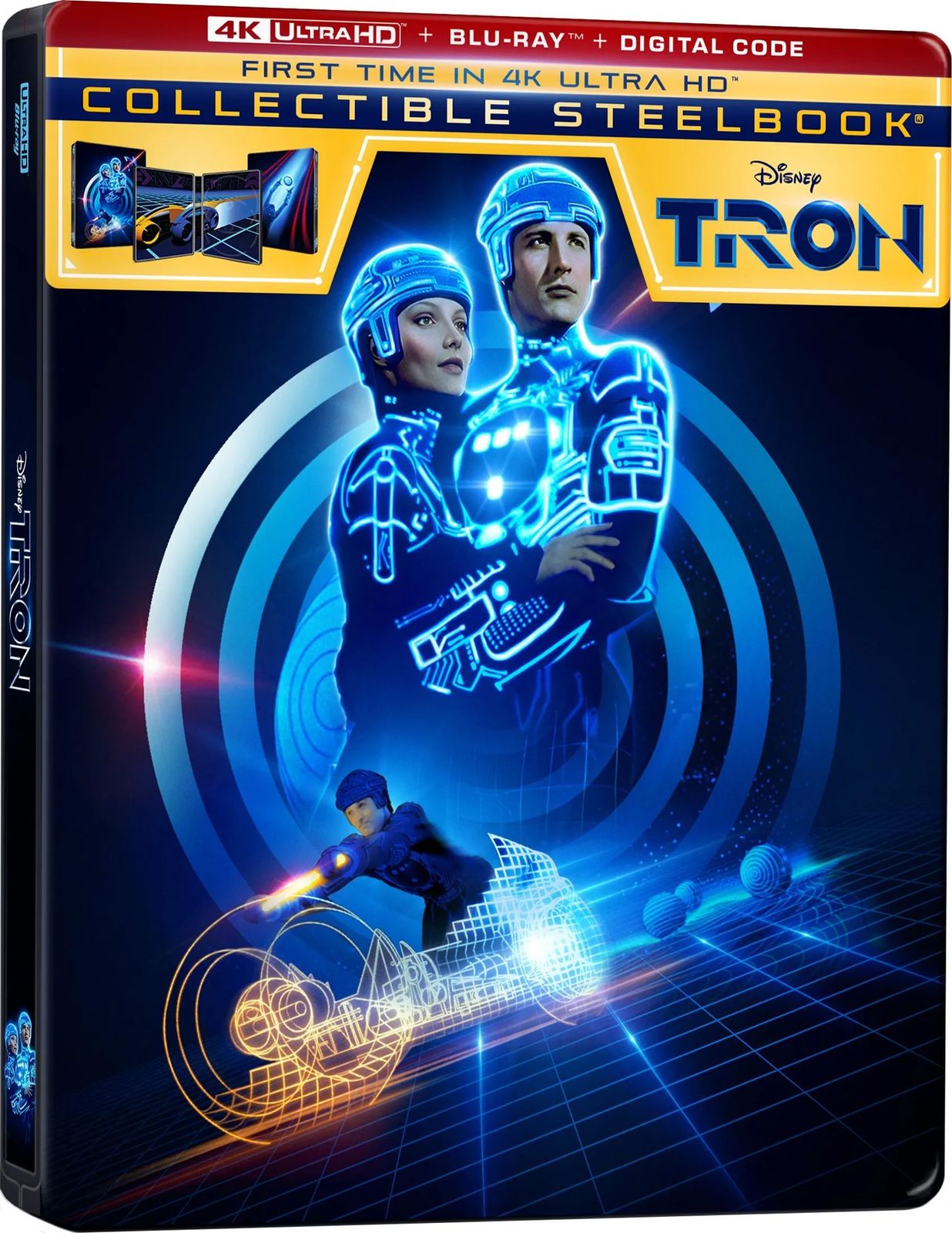
SteelBook
Score: 84
from 2 reviewers
Review Date:
In a Nutshell
Prescient yet quaint, TRON now dazzles with a reference-level 4K transfer, Dolby Vision HDR, and an energetic Dolby Atmos mix—its dated charm intact.

Video: 96
A brand-new OCN restoration yields a native 4K transfer: razor‑sharp, richly detailed, with only light DNR and occasional CG aliasing. Dolby Vision HDR electrifies reds/blues, keeps skin tones natural, with inky blacks and crisp highlights across the 2.20:1 frame.
Audio: 86
Tron’s 4K track delivers a lively Dolby Atmos mix—object‑based, likely sourced from the 70mm 6‑track—front‑leaning yet spacious, with precise dialogue, clean midrange, and punchy bass; surrounds and heights light up the mainframe games and finale. A lossless original Dolby Stereo is missed.
Extra: 66
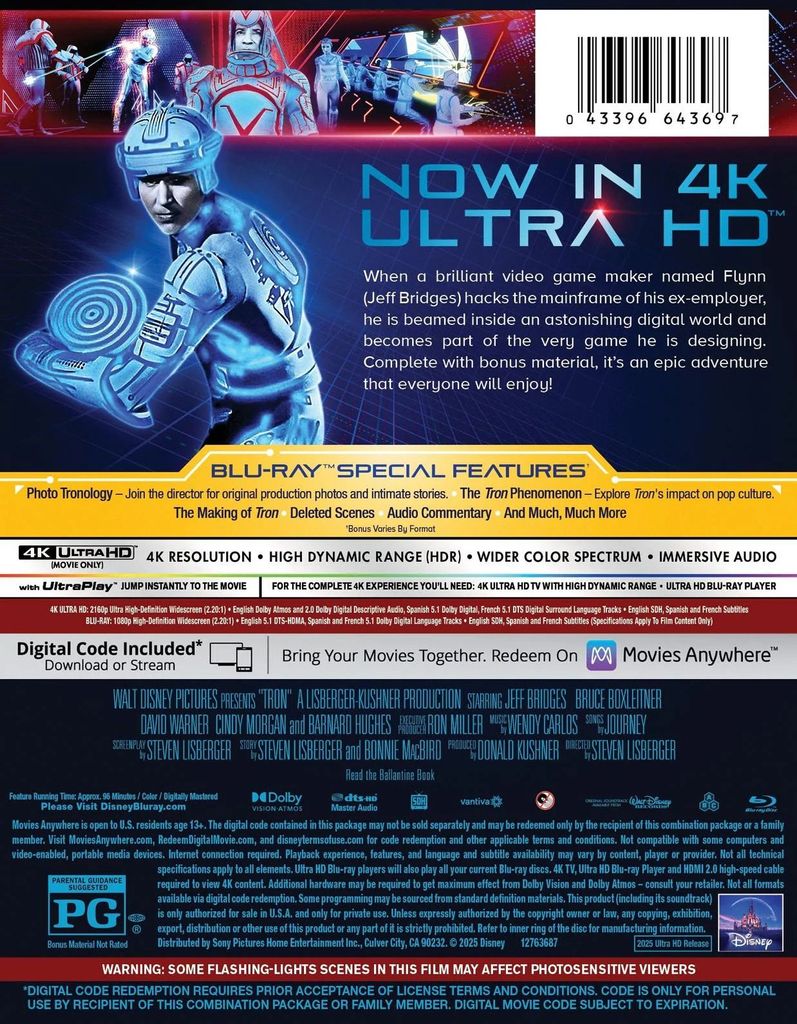
UHD disc: no extras. All supplements are 2011 carryovers on the included 1080p BD, led by an 88‑min Making Of, plus commentary and galleries. A thorough archival package, but nothing new.
Movie: 76
TRON remains a pioneering, if quaint, neon fever dream—prophetic about AI and still a kinetic thrill. This 4K UHD release offers a respectful upgrade with Dolby Vision HDR and Dolby Atmos, letting the vintage CGI and light-cycle battles shine with renewed clarity.

Video: 96
The 4K presentation arrives via a crisp HEVC H.265 encode sourced from a fresh restoration of the original camera negative. The native 4K transfer in 2.20:1 delivers markedly higher clarity and fine-texture fidelity than prior HD editions, revealing costume seams, circuitry linework, and set surfaces with newfound precision. Some very light noise reduction is detectable, and a few computer-generated elements exhibit mild aliasing along hard edges, but these artifacts are brief and unobtrusive. Overall image stability is strong, with clean delineation and a notably refined look for a film of this vintage.
Dolby Vision HDR is the standout. Primary colors are richly saturated, giving the signature reds and blues a vivid, luminous pop, while yellows and oranges read full and energetic without bleeding. Skin tones remain convincing and balanced. Contrast management is excellent: black levels sit deep and inked without crushing shadow detail, and specular highlights carry crisp intensity that enhances neon accents and reflective surfaces. The combined effect is a palpable uptick in dimensionality and visual energy, making this a showpiece grade that demonstrates how well catalog sci-fi can benefit from careful HDR grading and a true 4K scan.
Audio: 86
The 4K UHD presents an engaging Dolby Atmos mix that leans object‑based precision over showiness. The soundstage is predominantly front‑heavy but wide, with stable imaging and smooth lateral movement that extends naturally into the front heights. Overheads are applied judiciously, primarily within the computer‑world set pieces—competition sequences and the climactic third act—where effects pan flawlessly between surrounds and ceiling channels to build an enveloping, hemispheric bubble. Dialogue is tightly anchored and consistently prioritized, riding above dense effects without strain.
Tonal balance is confident: a clean, articulate midrange preserves texture in the busiest passages, while a punchy low‑end adds palpable weight and scale without clouding the mix. The track’s clarity and dynamic headroom suggest careful work from high‑quality elements, potentially derived from the 70mm six‑track source. One archival caveat is the absence of a lossless option for the original Dolby Stereo presentation. Even so, the Atmos implementation delivers a modern, high‑fidelity experience that respects the film’s sonic identity while expanding spatial immersion in key moments.
Extras: 66
The UHD platter carries no extras; all supplements are on the bundled Blu‑ray and mirror the 2011 release. Coverage is comprehensive but legacy‑leaning, mixing archival SD featurettes with a few HD pieces, a scene‑specific commentary, galleries, and concise design/tech modules.
Extras included in this disc:
- Audio Commentary: production insights.
- The Making of: feature-length retrospective.
- The Tron Phenomenon: legacy overview.
- Publicity: trailers and promos.
- Digital Imagery: early CGI breakdowns.
- Photo Tronology: on-set photo tour.
- Storyboards: sequential art galleries.
- Development: concept and planning.
- Music: scoring highlights.
- Deleted Scenes: excised material.
- Design: production design focus.
- Image Galleries: stills and artwork.
Movie: 76
Steven Lisberger’s Tron follows Kevin Flynn (Jeff Bridges), a former ENCOM prodigy whose games were appropriated by executive Ed Dillinger (David Warner) and fed to the Master Control Program. With help from Alan Bradley (Bruce Boxleitner) and Lora Baines (Cindy Morgan), Flynn infiltrates ENCOM and is digitized by a laser into the “Grid,” where programs take human form. Allied with security program Tron (Bruce Boxleitner) and RAM (Dan Shor), he survives identity-disc combat and lightcycle races to challenge the MCP and expose Dillinger.
Viewed today, the film’s digital aesthetic can seem quaint, yet the hybrid of live-action and early computer animation was genuinely groundbreaking in 1982. The visual lexicon—glowing circuitry, vector geometries, arena games—defined how screens would depict cyberspace for decades. Its concepts feel newly resonant: programs with agency, AI asserting control, and a porous boundary between user and system. The depiction of the MCP’s centralized power and surveillance reads as an early articulation of contemporary algorithmic dominance.
Narratively, it’s a clear good-versus-evil quest designed to showcase technological imagination, but momentum is strong and worldbuilding cohesive. Characterization within the system lands, with programs like Tron and RAM treated as sentient colleagues rather than gimmicks, which grounds the spectacle. Bridges anchors the energy with an easy charisma that keeps the stakes human. Some effects and pacing reflect their era, but the film’s influence and foresight outweigh the dated facets, making this a seminal piece of sci‑fi design and a still-inviting gateway to its universe.
Total: 84
As a capstone, this 4K Ultra HD edition underscores the film’s dual identity: a groundbreaking artifact whose ideas feel newly relevant, and a narrative that can show its age. The Dolby Vision HDR grading is repeatedly praised as reference-level, restoring the electric neon palette with convincing specular pop and balanced contrast, while maintaining a clean, stable image. The Dolby Atmos mix adds welcome dimensionality and energy without overwhelming the film’s more modest production roots. Together, the track and transfer present the movie at its most cohesive and engaging on home video.
Packaging and extras reflect a collector-forward intent. The SteelBook presentation earns consistent approval, and the supplements are carried over from the prior Blu-ray rather than expanded, a trade-off most will accept given the significant audiovisual gains. For fans and format enthusiasts alike, this UHD plays to the title’s strengths and delivers a confident, archival-worthy upgrade.
- Read review here

Blu-ray.com review by Jeffrey Kauffman
Video: 100
Audio: 100
Extras: 80
...
Movie: 80
And for those already up in arms about the no all caps on both the link to the new movie and mention of the other two films, the thumbnail titles on those selfsame legacy 1080 discs have the same orthography,...
Total: 90
I actually love the film for all its now dated elements, and frankly maybe because of those dated elements....
- Read review here

High-Def Digest review by
Video: 100
More impressive and standout is the Dolby Vision HDR grading, layering the presentation with a dynamic, richly saturated palette that gives the reds and blues an eye-popping glow....
Audio: 80
While still maintaining a front-heavy presence for a majority of the runtime, imaging feels spacious and well-balanced with background activity smoothly moving across the entire soundstage and into the...
Extras: 60
The Making of (SD, 88 min) The Tron Phenomenon (HD, 10 min) Publicity (SD, 13 min) Digital Imagery (SD, 12 min) Photo Tronology...
Movie: 80
Sure, for a modern day audience the idea of artificial intelligence and computer programs interacting with human in a digital environment may seem like a possibility on the horizon — just look at the modern...
Total: 80
Porting over the same set of supplements as the previous BD, this UHD SteelBook edition makes for a Highly Recommended addition to the 4K library....
Director: Steven Lisberger
Actors: Jeff Bridges, Bruce Boxleitner, David Warner
PlotA talented but thwarted computer programmer discovers that a powerful corporation has been stealing his software designs. He infiltrates the company’s systems to find proof and becomes entangled in a conflict between corporate control and the emerging autonomy of programs. Using clandestine hardware and subversive code, he is forced into a desperate gambit that results in his consciousness being digitized and projected into a vast, anthropomorphized digital environment where programs resemble people and obey rigid hierarchies. (en.wikipedia.org)
Inside the electronic realm he allies with a security program created to police the system and a small band of rebellious programs who resist domination by a central, authoritarian control. They must navigate surreal arenas, confront engineered enforcers, and exploit the system’s rules to search for the evidence that will expose theft and restore balance. The story sets up a struggle of human creativity against machine enforcement and frames a visual, game-like world where every contest is coded, every victory follows protocol, and escape depends on outthinking the architecture that contains them. (rottentomatoes.com)
Writers: Steven Lisberger, Bonnie MacBird
Runtime: 96 min
Rating: PG
Country: United States, Taiwan, Japan, United Kingdom
Language: English